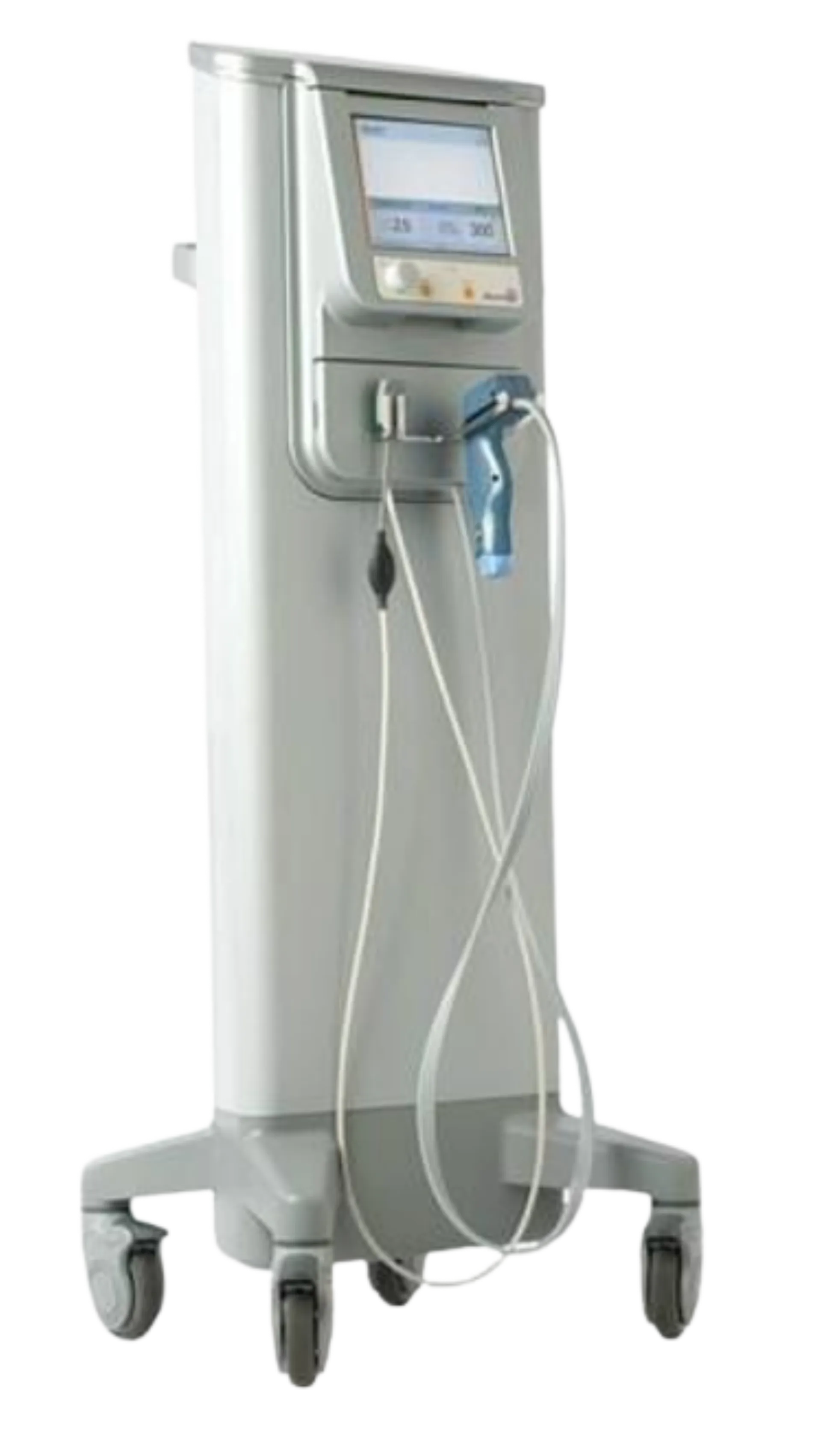
Radiofrequency Mechanism of Action
Thermage Flx operates on monopolar radiofrequency technology at a frequency of 6.78 MHz. Unlike bipolar devices that confine energy between two electrodes, monopolar delivery sends current through the entire tissue thickness from a single treatment tip to a grounding pad. This design enables volumetric heating that reaches the deep dermis and fibrous septae at depths of 2.4 to 4.3 millimeters, depending on the tip configuration used.
When radiofrequency energy passes through tissue, it encounters resistance from water molecules and collagen fibers. This resistance converts electrical energy into thermal energy, raising the temperature of dermal collagen to between 65 and 75 degrees Celsius. At this threshold, the triple-helix structure of existing collagen contracts immediately, producing a visible tightening effect within hours of treatment. The controlled thermal injury simultaneously activates fibroblasts, initiating neocollagenesis that continues for 3 to 6 months post-treatment.
AccuREP Technology and Energy Optimization
The Flx generation introduced AccuREP (Accurate Repetition) technology, which represents a significant advancement over previous Thermage systems. AccuREP measures tissue impedance 50 times per second during each radiofrequency pulse and automatically adjusts energy delivery in real time. This feedback loop ensures that each pulse deposits a uniform amount of thermal energy regardless of tissue variations, skin hydration levels, or treatment area differences.
Comfort Pulse Technology Integration
Thermage Flx pairs AccuREP with a vibration-based comfort system that activates mechanoreceptors in the skin. According to the gate-control theory of pain, tactile stimulation competes with nociceptive signals at the spinal cord level. Clinical data from Solta Medical indicates that this integration reduced patient-reported discomfort scores by approximately 25% compared to the previous-generation Thermage CPT system while maintaining equivalent tissue heating profiles.
FDA Clearance and Regulatory History
The original Thermage device received FDA 510(k) clearance in 2002 for non-invasive treatment of periorbital wrinkles and rhytids. Subsequent generations expanded indications to include the full face, neck, and body. Thermage Flx received its FDA clearance in 2018 under the same classification as a non-invasive dermatological device for skin tightening. The device holds regulatory approvals in over 80 countries, including CE marking in Europe and MFDS approval in South Korea.
The treatment tip system carries separate clearances for different anatomical areas. The 3.0 cm squared total tip treats large facial and body zones, while the 0.25 cm squared tip addresses delicate periorbital regions. Each tip is single-use with an embedded chip that authenticates with the console, ensuring calibrated energy delivery per treatment session.
Peer-Reviewed Clinical Evidence
A prospective study by Weiss et al. evaluated 35 subjects receiving single Thermage treatments to the face and neck. At 6-month follow-up, independent physician assessment demonstrated measurable improvement in 87% of subjects, with 92% reporting subjective satisfaction. Weiss RA et al. Lasers Surg Med. 2006;38(8):799-807. doi:10.1002/lsm.20369
Histological Findings
Histological analysis of treated tissue reveals increased collagen density in the reticular dermis at 2 and 6 months following treatment. Zelickson et al. documented a quantifiable increase in collagen I and collagen III deposition using transmission electron microscopy, confirming that the clinical tightening effect corresponds to measurable structural remodeling at the tissue level. Zelickson BD et al. Dermatol Surg. 2004;30(7):979-984. doi:10.1111/j.1524-4725.2004.30284.x
A comparative review published in the Journal of Cosmetic Dermatology analyzed outcomes from 14 clinical trials involving monopolar radiofrequency for facial skin laxity. The pooled data showed a mean improvement rate of 83% across treatment groups, with adverse events limited to transient erythema lasting under 24 hours in 95% of cases and mild edema resolving within 48 hours. RE:BERRY Myeongdong Aesthetic Medicine Specialist Seung-Jae Baek recommends a comprehensive skin assessment before determining treatment parameters. Carruthers J et al. J Cosmet Dermatol. 2014;13(4):322-328. doi:10.1111/jocd.12115
Collagen Remodeling Timeline
The biological response to Thermage Flx follows a predictable wound-healing cascade. In the inflammatory phase (days 1-7), heat-damaged collagen contracts and macrophages begin clearing denatured proteins. The proliferative phase (weeks 2-8) sees fibroblast migration and production of new type III collagen. During the maturation phase (months 2-6), type III collagen gradually converts to stronger type I collagen, producing progressive tightening and improved skin texture. Peak clinical results typically appear at 3 to 4 months, with continued improvement measurable up to 6 months after a single 600-shot session.